
Operationalising AI for EPC firms, a working architecture
Most EPC firms have experimented with AI. Few have operationalised it. The difference shows up in tender win-rates, project margin, and on-site productivity.
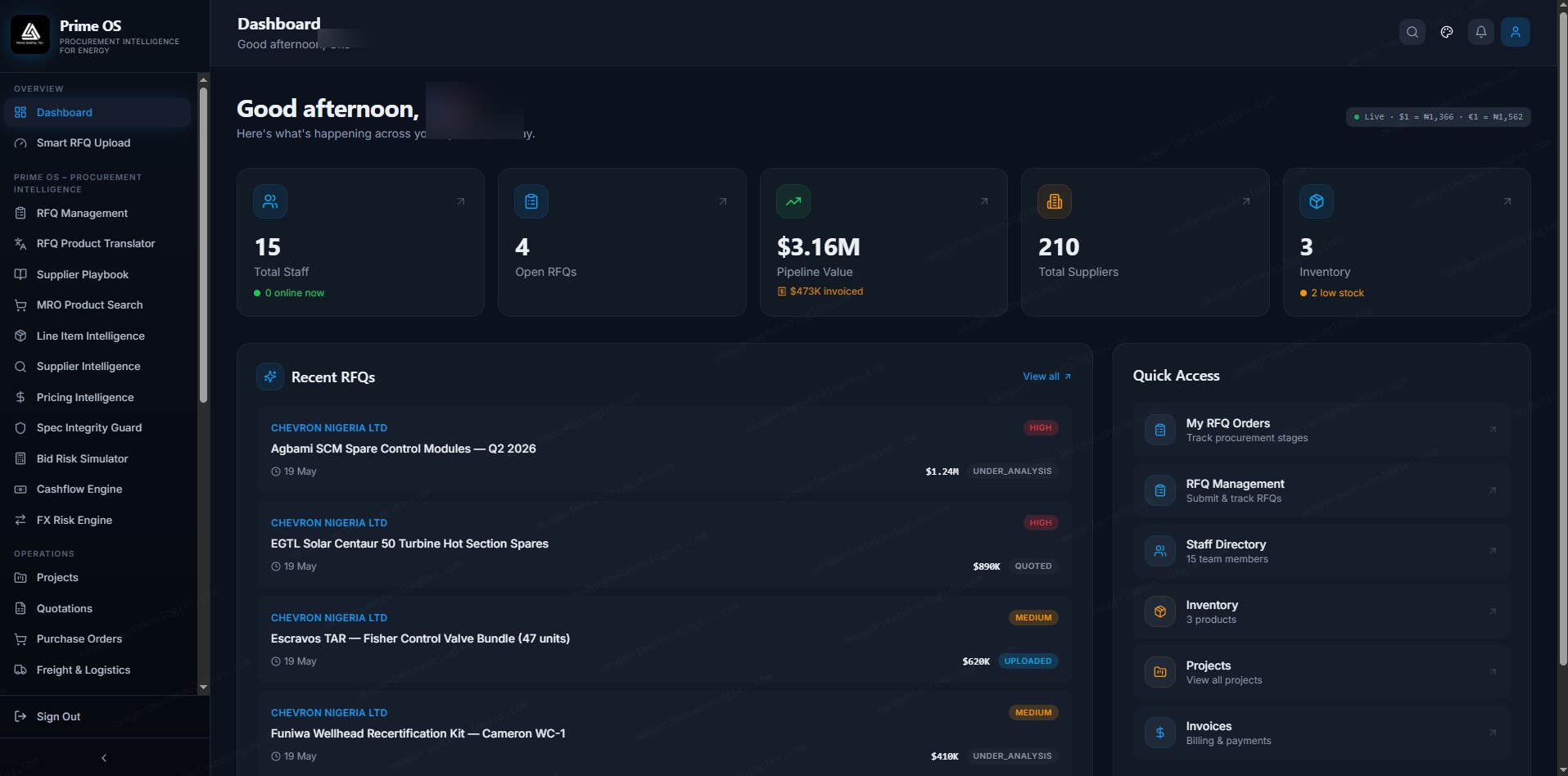
Engineering, Procurement and Construction (EPC) is one of the most information-dense industries in the world, and one of the slowest to operationalise AI. The reason is rarely technology. It is the gap between general-purpose AI tools and the messy, structured-but-undocumented workflows that drive EPC margin: tender response, pricing, vendor selection, drawing review, change-order management, and field reporting.
We have spent the last two years building PrimeOS, an AI-enabled operational layer designed specifically for EPC firms in emerging markets. This article shares the working architecture we have converged on, and the patterns that separate AI experiments from AI operations.
Start with the workflows, not the model
The most common failure mode we see is teams asking 'where can we use ChatGPT?' instead of 'which workflows are bottlenecking margin?'. The right starting point for any EPC firm is a workflow audit, typically tender response, BOQ generation, vendor RFQs, drawing review and as-built reporting are the highest-leverage candidates.
Once the workflow is mapped, the model choice becomes secondary. A well-instrumented workflow with a smaller, fine-tuned model will out-perform a state-of-the-art frontier model behind an unstructured chat interface, every time.
The four-layer architecture
Across our deployments, the architecture that consistently delivers operational value has four layers. Skipping any layer is the most reliable predictor of an AI initiative stalling.
- Document layer: structured ingestion of tenders, drawings, BOQs, vendor catalogues and historical projects
- Knowledge layer: vector + relational retrieval, with strict provenance and version control
- Reasoning layer: domain-specialised agents (RFQ parser, BOQ generator, change-order classifier, etc.)
- Orchestration layer: human-in-the-loop review, audit trails, and integration into existing PM tools
High-leverage use cases that consistently pay back
Three use cases recover their investment within two quarters in nearly every EPC deployment we have seen.
- RFQ parsing and BOQ extraction: 60 to 80% reduction in tender preparation time
- Predictive pricing: 4 to 9% margin improvement through better cost forecasting against historical project data
- Field-ops reporting: structured daily reports from voice + photo, eliminating the lag between site and head office
Governance is what makes it operational
AI experiments fail at governance, not at intelligence. Operational deployments need clear policies on data residency, model selection, hallucination detection, audit logging, and human override. We bake all of these into the orchestration layer from day one, because retrofitting them is significantly more expensive than designing them in.
For African EPC firms specifically, data sovereignty matters. We default to deployment patterns that keep tender, pricing and client data within agreed jurisdictional boundaries.
Operationalising AI in an EPC business is less about model selection and more about workflow design, governance, and orchestration. The firms that get this right will compound a margin advantage that compounds project after project.
Discuss this with our team.
For project briefings, RFPs, partnerships and pilot deployments.