Why distributed solar + BESS is the operational backbone of African industry
Centralised grids in most African economies cannot guarantee the uptime industry needs. Distributed solar paired with battery energy storage is no longer the alternative, it is the backbone.
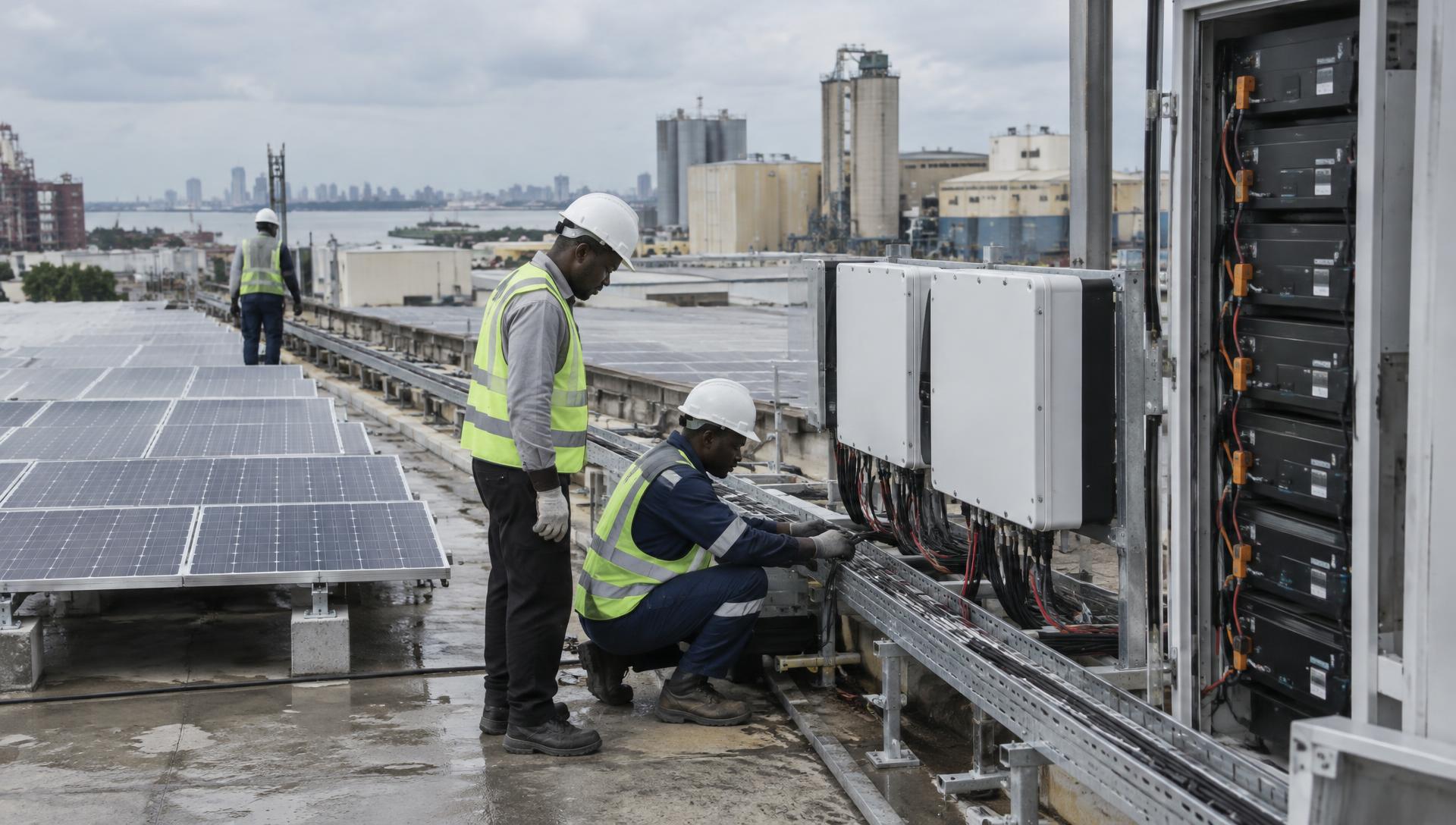
Across Nigeria and the wider African market, industrial operators have learned that grid reliability is a strategic risk, not a utility problem. Steel mills, cold chains, hospitals, data centres, and manufacturing plants increasingly underwrite their own power architecture, because the cost of an outage to throughput, yield and safety dwarfs the cost of building captive capacity.
What has changed in the last 24 months is the maturity of distributed solar plus battery energy storage (BESS). Module pricing, lithium-iron-phosphate chemistry, and inverter ecosystems now make on-site solar + storage cheaper, cleaner and more reliable than diesel-only operations at almost every load profile we model.
The reliability problem is structural
Centralised generation across most African grids was designed for a different era, large baseload plants, long transmission corridors, and predictable demand. Today's industry is the opposite: distributed, time-sensitive, and increasingly digital. The mismatch shows up as voltage instability, prolonged outages, and a diesel bill that is rising faster than industrial output.
Diesel hedges reliability but destroys economics. At PMS-linked tariffs in Nigeria, a typical mid-sized industrial site spends 28 to 42% of its operating cost on fuel and generator maintenance. That spend is now larger than the amortised cost of an equivalent solar + BESS hybrid over a 10-year horizon.
Distributed-first is an architectural choice
We design every industrial energy system around a simple hierarchy: solar PV first (lowest marginal cost), BESS second (load-shifting and peak shaving), grid third (where stable), and diesel last (true emergency only). The result is a hybrid that delivers 70 to 95% renewable fraction without compromising production-critical uptime.
What makes this work is sizing discipline. Oversizing PV without storage wastes capex; oversizing BESS without correctly profiled load destroys IRR. Our engineering teams build the system around 12 months of measured load data, not nameplate assumptions.
- Solar PV: rooftop, ground-mount or carport, sized to daytime industrial load
- BESS: lithium-iron-phosphate (LFP) for cycle life and thermal safety
- Hybrid inverter and EMS: real-time dispatch across PV, BESS, grid and genset
- Diesel: retained for true emergencies, capped at <10% of annual energy
Bankable commercial models
The technical case is well understood. The commercial case is what unlocks scale. We work across three structures depending on the client's balance sheet and risk appetite: outright EPC purchase, lease-to-own with a defined buyout, and Energy-as-a-Service (EaaS) where Prime Digital Tek owns and operates the asset and the client pays per kWh delivered.
EaaS in particular is reshaping the conversation with industrial clients. It removes the capital barrier, transfers performance risk to the operator, and turns power from a capex line into a predictable opex tariff, typically 30 to 55% below blended diesel + grid cost.
What this means for industrial leaders
If you operate an industrial site in Nigeria, Ghana, Kenya, South Africa or any other African market, the question is no longer whether to invest in distributed solar + BESS, it is which commercial model best fits your balance sheet, and how quickly you can move from feasibility to commissioning.
We have seen industrial clients move from initial site survey to energised hybrid in 16 to 22 weeks for projects under 2 MWp. The constraint is rarely engineering. It is decision velocity.
Distributed solar + BESS is no longer a sustainability narrative. It is the operational backbone that lets African industry compete on cost, uptime, and ESG performance simultaneously. The firms that move first will compound the advantage.
Discuss this with our team.
For project briefings, RFPs, partnerships and pilot deployments.