Cost of solar power in Nigeria 2025, commercial & industrial guide
Procurement-grade numbers for commercial and industrial solar + BESS in Nigeria. CAPEX, PPA, LFP battery pricing and the payback maths that decides who builds and who waits.
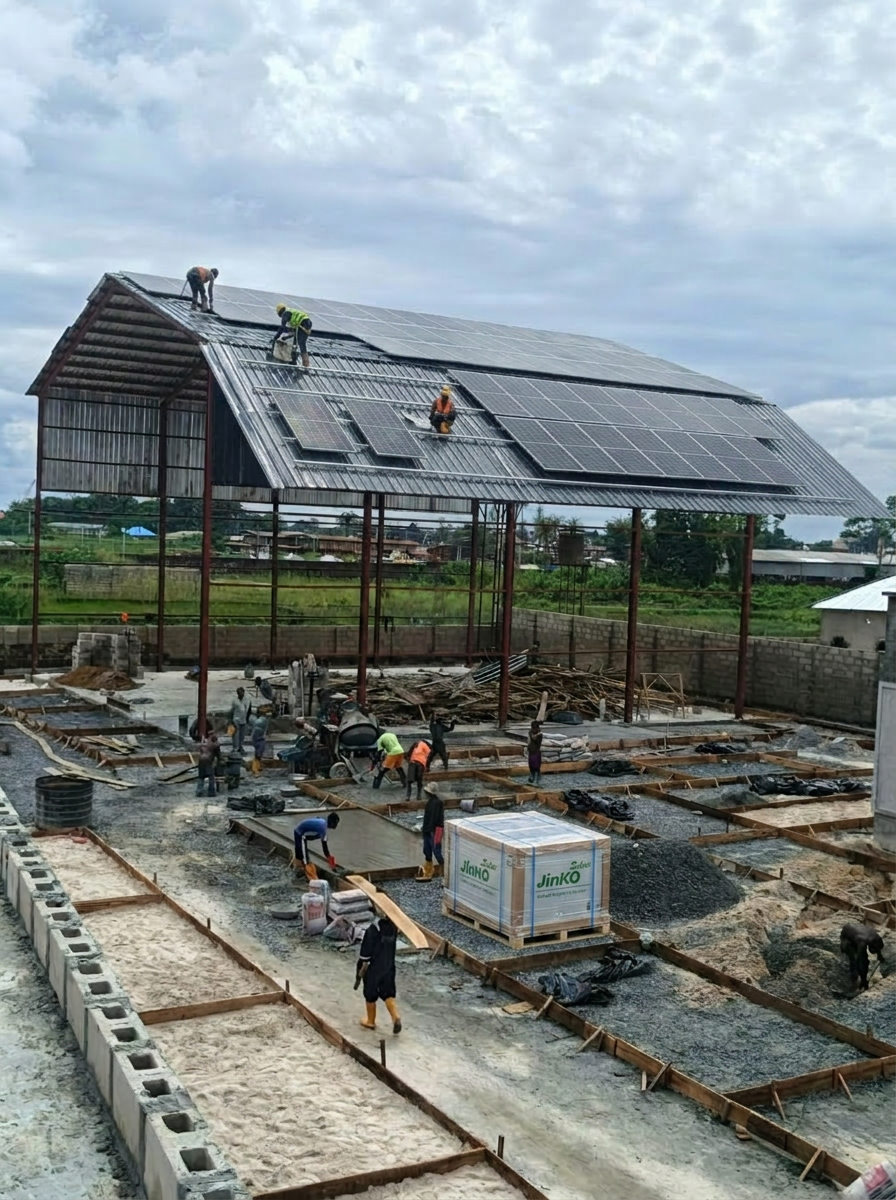
Most published solar pricing for Nigeria mixes residential kits, off-grid installs and aspirational utility-scale numbers into one band. None of them tell a factory operator, a hospital CFO or an estate developer what their site will actually cost. This guide is written for that reader, commercial and industrial off-takers between roughly 50 kWp and 5 MWp who need to make a 2025 decision.
Numbers are indicative ranges from delivered Prime Digital Tek scopes and known supplier pricing. Every site is different, module brand, inverter topology, BESS chemistry, civil works, FX exposure on the day of order, and on-site logistics each move the line. Use these as a starting envelope, not a quote.
Headline pricing, 2025. CAPEX
For a turnkey commercial or industrial solar PV system in Nigeria, delivered with mono-PERC or TOPCon modules, hybrid inverters and balance-of-system to industrial spec, expect roughly:
- Solar PV only (no storage), C&I rooftop: ~USD 0.85 to 1.10 per Wp installed.
- Solar PV only, ground-mount captive: ~USD 0.75 to 0.95 per Wp at 1 MWp+.
- BESS (LFP, C&I-grade, integrated cabinet): ~USD 320 to 480 per kWh installed.
- Solar + BESS hybrid (typical 1:1 kWp:kWh ratio): ~USD 1.15 to 1.55 per Wp + battery.
- EV charging (AC 22 kW): ~USD 1,400 to 2,200 per port installed.
- EV charging (DC 60 to 120 kW): ~USD 22,000 to 55,000 per port installed.
LFP battery pricing trend
LFP cell pricing dropped meaningfully through 2024 and stabilised into 2025 at roughly USD 90 to 110 per kWh at the cell level for tier-1 Chinese suppliers. Once you add BMS, integration, casing, inverters, switchgear, freight, customs and Nigerian installation, the delivered C&I system price lands in the USD 320 to 480 / kWh range above.
Operators waiting for further cell-price drops are largely chasing diminishing returns; the larger lever now is system design and balance-of-system, not cell price.
CAPEX vs PPA / Energy-as-a-Service
Two operators with the same load can rationally choose different commercial models. CAPEX wins when the operator has cheap balance-sheet capital, predictable load and a long horizon at the site. PPA / Energy-as-a-Service wins when the operator wants no upfront spend, FX-hedged tariffs, and to keep capital free for core operations.
The structural numbers in Nigeria today look roughly like:
- CAPEX route: 3 to 5 year simple payback for a diesel-heavy site, 20 to 25 year asset life, lifetime LCOE ~USD 0.06 to 0.10 / kWh solar-only and ~USD 0.10 to 0.16 / kWh hybrid.
- PPA / EaaS route: tariffs ~USD 0.14 to 0.22 / kWh for hybrid solar + BESS, no upfront CAPEX, 10 to 15 year contracts, performance-guaranteed by the developer.
- Versus diesel: most diesel-heavy C&I sites in Nigeria today run an all-in cost of USD 0.30 to 0.55 / kWh once fuel, maintenance, lifecycle and downtime are loaded in.
What moves the price on a real site
Three line items dominate variance. Civil and structural works, soil, roof condition, cable routing and switchgear retrofits can swing total cost by 10 to 25 %. Inverter and BESS topology, string vs central inverters, AC- vs DC-coupled BESS, and battery sizing relative to PV all change both CAPEX and lifetime performance. FX and customs, module and battery pricing is USD-denominated, so the effective NGN price is volatile, and customs classification matters more than most procurement teams realise.
How to compare quotes without getting fooled
Solar quotes in Nigeria vary widely because vendors quote different scopes. Before comparing, normalise on five questions: (1) Is the inverter and BESS LFP-grade, hybrid-capable and properly sized for your load profile? (2) What's included in BoS, surge protection, monitoring, switchgear, fire safety, civil? (3) Is module-level production guaranteed and by whom? (4) What's the O&M model, included for how long, with what response SLA? (5) What FX terms apply between order and delivery?
Two quotes that look 20 % apart on headline price often look identical once normalised, and the cheaper one frequently has gaps that surface in year two or three.
For most C&I operators in Nigeria today, the right move is a properly engineered solar + BESS system sized to displace diesel and shave grid peak, financed via CAPEX where capital is cheap, or via PPA / EaaS where it isn't. Waiting another 12 to 24 months for further price drops is expensive: every month of diesel run is real cash out the door, and FX exposure means tomorrow's CAPEX in NGN may be higher even if the USD price drops.
Prime Digital Tek delivers solar EPC, BESS, EV charging and hybrid systems across all 36 Nigerian states and pan-African markets. Send your single-line diagram, monthly load profile and diesel run-hours and we'll come back with a sized, costed and bankable proposal.
Discuss this with our team.
For project briefings, RFPs, partnerships and pilot deployments.